Savings Rate: Why the Percentage Beats the Amount
A fixed dollar amount ages badly. A percentage of income moves with your life, survives a raise, and answers the only question that matters over decades: how much of what you earn is actually becoming yours. This guide explains how to compute your true savings rate, why a change of ten percentage points moves your working years more than a change of ten thousand dollars, and how to raise the rate without pretending you will cook every meal at home.
Compute the number correctly
Savings rate is not savings divided by salary. It is (take-home pay minus spending) divided by take-home pay, where spending includes everything that left your accounts, including debt principal. Someone who earns $6,000 net, spends $5,100 and sends $400 to a credit card has a true rate of 15 percent, not the 5 percent that a bank-transfer view suggests.
Include employer retirement contributions. If your employer puts $300 into a plan on your behalf, that $300 is compensation you chose to save, and leaving it out understates the rate by five percentage points in the example above. Exclude transfers between your own accounts, or the number will swing with every move to savings.
Why ten points beats ten thousand
Raising income raises the rate only if spending stays flat, and spending rarely stays flat: it is the line that grows with income by default. Raising the rate by ten points, by contrast, does two things at once. It increases the amount saved each year, and it reduces the annual spending that the portfolio eventually has to replace. You are pushing from both ends.
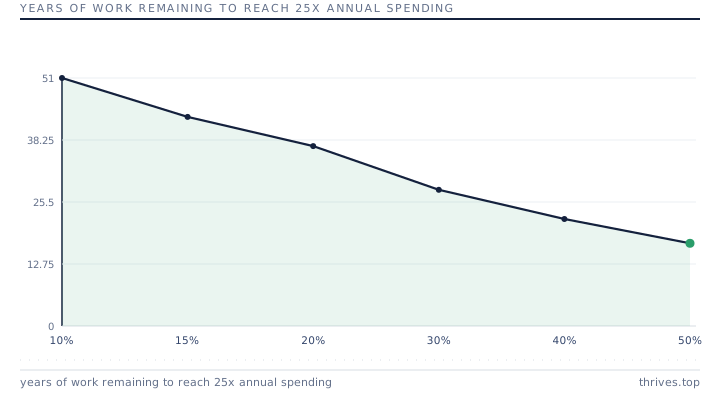
The arithmetic is why the percentage matters more at the start than at the end. Going from a 10 percent rate to a 20 percent rate does not double your working years remaining, it cuts them by roughly a quarter, because the target is spending-based rather than income-based.
Raise it with three moves, in order
First, automate the increase, not the level. Every time income rises, route half the raise into savings before it reaches your checking account. Half a raise is invisible; a full raise redirected feels like a pay cut and gets reversed within two months.
Second, attack the fixed-cost floor. Housing and transport are the two lines big enough to move a rate by five points in one decision, and they are also the two lines people renegotiate least often. Re-pricing insurance and refinancing existing debt usually moves the rate by one to three points with no lifestyle change at all.
Third, add a temporary rule rather than a permanent one. A six-month rule, for example no new recurring subscriptions, is easier to hold than a permanent ban, and it leaves you with a rate you can maintain instead of a rate you abandon.
Pick a rate you can hold for a decade
The useful target is not the highest rate you can survive for a quarter. It is the highest rate that does not require you to be a different person. If your rate requires an hour of meal prep every night and you know you will not do that in February, it is not your rate; it is a rate you will quit.
A practical method is to raise the rate by one point per quarter and stop raising when two consecutive quarters feel strained. Most households with a stable income settle between 15 and 25 percent, and the number that matters is not where you settle but that the line keeps going up rather than resetting every January.
What to take away
- Savings rate is (take-home minus spending including debt principal) divided by take-home.
- Count employer contributions; ignore transfers between your own accounts.
- A ten-point rate increase shortens working years more than a ten-thousand-dollar raise.
- Automate the raise split, then the fixed cost floor, then temporary rules.
- Pick a rate you can hold for ten years, not a rate you can survive for three months.
Try your own numbers
| Savings rate | Years |
|---|---|
| 10% | 51.3 |
| 15% | 43.0 |
| 20% | 36.7 |
| 30% | 27.9 |
| 40% | 21.6 |
| 50% | 16.7 |
Disclaimer: This guide is educational information about personal money management, not financial, tax or investment advice. Projections are simplified illustrations that ignore taxes, fees and investment returns.