How Big Should Your Emergency Fund Be? A Month-by-Month Method
Most advice stops at three to six months, which is a range, not a plan. This guide builds the number from your own essential spending, tells you what counts as essential and what does not, and gives you a first milestone you can hit in about ninety days. It also covers where the money should sit, and the part almost nobody plans for: what to do in the month after you actually spend it.
Start with a floor, not a target
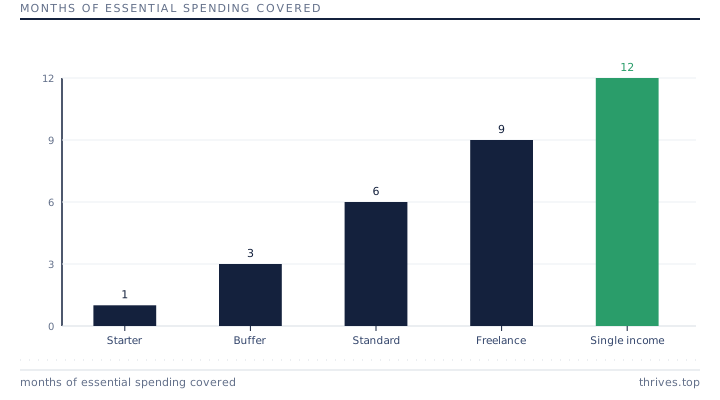
The mistake is aiming straight at six months. Six months of essential spending for a household with $3,200 of monthly essentials is $19,200, and a target that size gets abandoned by month three. Instead set a floor: one month of essentials, held in cash and reachable in a day. For that same household the floor is $3,200, which most people can reach in one to three months by pausing one recurring cost and redirecting it.
The floor is not the goal. It is the point at which a small emergency stops turning into credit card debt. Once you are there, you keep going, but you keep going at a pace you can hold for a year rather than a pace you can hold for six weeks.
Price your own month
Pull the last three months of statements and sort every transaction into two buckets: things you must pay to keep the roof, the lights, the car and the food, and things you chose. Rent or mortgage, utilities, insurance, minimum debt payments, groceries, transport to work, and prescriptions go in the first bucket. Streaming, dining out, subscriptions, gifts and travel go in the second.
Add the essentials and divide by three to get your monthly essential figure. Then add a one-off line for the things that break on a schedule longer than a month: a car repair, a dental crown, a vet bill, a laptop. A common working number is 15 to 25 percent of the monthly essentials on top, set aside as a repair allowance. The fund covers the months; the allowance covers the surprises inside those months.
Where the money should sit
The fund needs two properties that rarely come together: it must not lose nominal value, and it must be reachable within one business day. That rules out individual stocks, long-dated bonds and anything with a lock-up, and it also rules out the checking account you spend from, because a balance you can see is a balance you will spend.
A workable arrangement is two layers. Layer one is one month of essentials in a savings account linked to your checking, transferred back the same day. Layer two is the rest in a separate high-yield savings account or money market fund at a different institution, where transfers take one to two business days. That small delay is a feature: it is long enough to stop an impulse withdrawal and short enough to cover a real emergency.
After you spend it, run a repair plan
The moment the fund does its job, two things are true: you were right to build it, and your protection just fell back to where it was a year ago. Decide in advance how you refill. The simplest rule that survives contact with real life is to redirect every discretionary line back into the fund until the floor is restored, then restore the discretionary lines one at a time in order of how much you actually use them.
Write the rule down before you need it. Households that decide the refill sequence while calm typically restore the floor in four to seven months; households that decide while recovering from the event usually do not restore it at all in the same year.
What to take away
- Set a one-month floor first, then extend; a target you can reach beats a target you admire.
- Your fund size is essential spending plus a repair allowance, not your take-home pay.
- Split the fund into a same-day layer and a one-to-two-day layer so it is reachable but not frictionless.
- Agree the refill rule before you spend the fund, not after.
Try your own numbers
| Savings rate | Years |
|---|---|
| 10% | 51.3 |
| 15% | 43.0 |
| 20% | 36.7 |
| 30% | 27.9 |
| 40% | 21.6 |
| 50% | 16.7 |
Related entries
Disclaimer: This guide is educational information about personal money management, not financial, tax or investment advice, and it does not account for your individual circumstances. Figures are illustrative examples.