Expense Ratios: Why One Percent Becomes Six Figures
A fee of one percent sounds small because it is quoted against assets, not against returns, and because it is charged quietly a fraction at a time. Over thirty years it can remove a fifth of a portfolio. This guide shows how to translate a percentage fee into the money it actually costs you, which fees are visible in a fund document and which are not, and the three questions to ask about any product that charges more than half a percent.
Translate the percentage into money
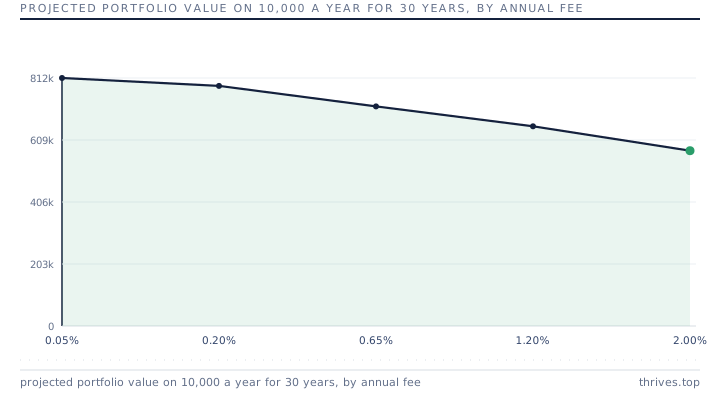
A fee is charged on the balance each year, so it compounds against you exactly the way returns compound for you. Investing 10,000 a year for thirty years at an average 6 percent return builds roughly 812,000 with a 0.05 percent fee, about 786,000 at 0.20 percent, and about 654,000 at 1.20 percent. The difference between the cheapest and the 1.20 percent version is 158,000, which is money that never appears on any statement.
The shortcut for mental arithmetic: over a thirty-year horizon, each 0.10 percent of annual fee costs roughly one percent of the final balance. A 1 percent fee therefore costs about ten percent of the final balance, and a 2 percent fee about twenty percent.
Visible and invisible costs
The ongoing charge on the fact sheet is the visible one. Invisible costs do not appear there: transaction costs inside the fund when it rebalances, the spread you pay when you buy, and any performance fee or platform charge levied outside the fund. For a broad index fund the invisible costs are small; for an actively traded fund in a narrow market they can exceed the stated fee.
A practical test: compare the fund's return with its benchmark over three and five years. If the gap is consistently more than the stated fee plus a small margin, the invisible costs are real and are being paid by you.
When paying more can be rational
There are cases where a higher fee buys something specific. A fund that holds physical assets in a market where settlement is difficult genuinely costs more to run. A fund that tracks an index with a difficult rebalancing process pays real transaction costs. A fund with a currency hedge costs the hedge.
What is rarely worth the money is paying for access to a market that a cheaper fund already covers, or paying for a manager's discretion in a segment where almost no manager outperforms after fees. Ask what specific thing the extra fee buys, and if the answer is not concrete, the answer is no.
Where fees hide in a portfolio
The total cost of a portfolio is not the average of its fund fees. It also includes advisory fees charged as a percentage of assets, platform or custody fees, and trading commissions if you rebalance often. A portfolio of 0.10 percent index funds held through an adviser charging 1 percent has a total cost of 1.10 percent, not 0.10 percent.
Add up every annual percentage you pay before judging whether the portfolio is cheap. Then compare that number with the arithmetic above, and decide whether what you receive for it is worth roughly a tenth of your eventual balance.
What to take away
- Over thirty years, every 0.10 percent of annual fee costs about one percent of the final balance.
- The stated ongoing charge is not the whole cost; transaction and platform fees sit outside it.
- A consistently larger tracking gap than the stated fee means invisible costs are being passed to you.
- Total portfolio cost is the sum of fund, advisory, platform and trading fees, not the fund fee alone.
Try your own numbers
| Year | Balance | Paid in |
|---|---|---|
| 5 | — | — |
| 10 | — | — |
| 15 | — | — |
| 20 | — | — |
| 25 | — | — |
| 30 | — | — |
Related entries
Disclaimer: This guide is educational information about investing, not investment advice. Projections are hypothetical, assume a constant return, and are not a prediction; actual returns and fees vary.