Snowball or Avalanche? Choosing the Debt Order That Actually Finishes
Both methods tell you to pay minimums on everything and throw every spare unit at one debt. They differ only in which debt gets the extra. Avalanche is cheaper on paper; snowball is more likely to be finished. This guide quantifies the difference with a worked example, lists the three cases where the choice is not close, and explains what to do with a zero-percent balance.
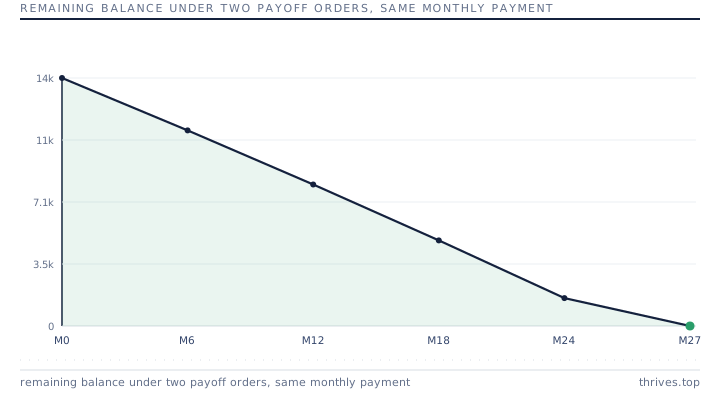
The two orders, stated precisely
Avalanche: rank debts by interest rate, highest first, and attack the top one. Snowball: rank by balance, smallest first, and attack the smallest. In both cases the monthly total stays fixed; when one debt closes, its payment rolls into the next one rather than disappearing into spending.
The rollover is the actual engine. A household paying $380 a month across four debts that keeps paying $380 after each closure clears the balances in a fraction of the minimum-only time. Without the rollover, neither method is much better than paying minimums forever.
What the difference is worth
Take four debts: $6,200 at 24 percent, $3,100 at 19 percent, $2,900 at 6 percent, and $2,000 at 0 percent promotional. With $380 a month, avalanche saves roughly $310 in interest over the life of the payoff compared with snowball, and finishes about one month earlier. That is a real but modest difference.
The gap widens when balances and rates are inversely related: a large low-rate loan and small high-rate cards. It narrows to almost nothing when the debts are similar in size, because then the two orders are nearly the same order.
When the choice is not close
Choose avalanche when the rate spread is large, meaning the top rate is more than twice the bottom rate, because the interest difference then runs into hundreds per year. Choose snowball when your history includes abandoned payoff attempts: the behavioural value of closing a balance in month two is worth more than the arithmetic you give up. Choose avalanche when a balance is sitting at a promotional zero percent that expires on a known date with retroactive interest, because that debt is not really zero percent.
In all three cases, the decision matters less than the rollover. A household that finishes with the more expensive method has done better than one that switches methods twice and finishes neither.
Handle promotional balances separately
A zero-percent balance has a hidden date. Read the terms for whether deferred interest applies, meaning interest accrues from the purchase date and becomes payable if the balance is not cleared by the deadline. If it does, that balance is not the cheapest debt on the list; it is the most expensive one, and it belongs first in the queue regardless of method.
If there is no deferred interest and the promotional rate simply expires into a normal rate, then it is genuinely the cheapest debt today and can sit at minimums until the month before the expiry date. Put that expiry date in your calendar with a reminder, because the month before expiry is when the ranking changes.
What to take away
- Both methods work only if the closed payment rolls into the next debt.
- Avalanche wins on interest; snowball wins on completion. The gap is usually one to three months.
- Pick avalanche when the top rate is more than double the bottom rate.
- Check promotional balances for deferred interest; if it applies, they go first.
Try your own numbers
| Debt | Balance | Rate | Min |
|---|---|---|---|
| Card A | 6,200 | 24% | 155 |
| Card B | 3,100 | 19% | 80 |
| Car loan | 2,900 | 6% | 72 |
| Promo | 2,000 | 0% | 50 |
Disclaimer: This guide is educational information about personal money management, not financial advice. The example figures are illustrative and ignore fees, taxes and credit score effects.