Emergency Fund: What Counts and What Does Not
An emergency fund is cash set aside for costs that are both unexpected and unavoidable. The definition has two halves, and most confusion comes from dropping one of them: a sale is unexpected but avoidable, and a car registration is unavoidable but expected.
Emergency Fund. An emergency fund is money held in cash or near-cash instruments, reserved for unexpected and unavoidable expenses, sized as a multiple of essential monthly spending and kept separate from the accounts used for daily transactions.
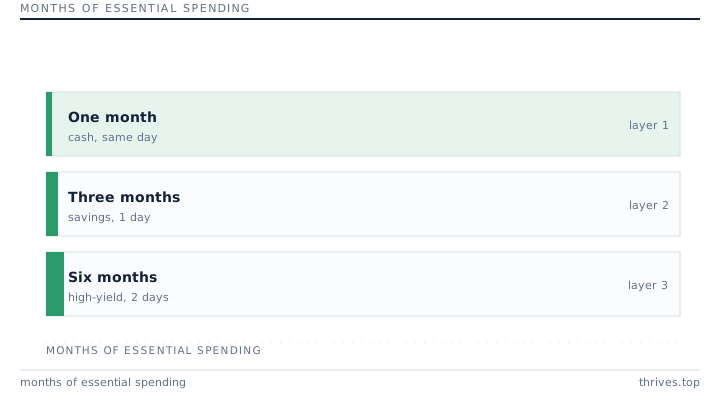
Worked numbers
A household with 3,200 of essential monthly spending holds one month (3,200) in a savings account linked to checking for same-day access and another five months (16,000) in a separate high-yield account. A broken water heater at 1,800 is paid from the first layer and restored over the next two months. A holiday in December is not taken from either layer, because the date was known in January.
The two-part test
Unexpected and unavoidable: both. Job loss, a medical bill, a car repair needed to get to work, a boiler failure in winter. These qualify. A discounted flight, a friend's wedding, a seasonal sale, a holiday that occurs in the same month every year — none of these qualify, because they were either avoidable or predictable.
Predictable costs belong in a sinking fund, where the amount is divided across the months before the due date. Moving predictable costs out of the emergency fund is what stops the fund from being spent every December and refilled every January.
Why cash rather than investments
An emergency fund's job is availability on a known date, not growth. Holding it in equities means a job loss during a market fall forces you to sell at the worst moment, which converts a temporary problem into a permanent loss. The return you give up by holding cash is the premium you pay for that certainty.
This is why the size of the fund and the size of the investment portfolio should be decided separately. A large portfolio is not a substitute for a cash buffer, because the moments you need the buffer are often the moments the portfolio is down.
Try your own numbers
| Savings rate | Years |
|---|---|
| 10% | 51.3 |
| 15% | 43.0 |
| 20% | 36.7 |
| 30% | 27.9 |
| 40% | 21.6 |
| 50% | 16.7 |
Disclaimer: This entry is educational information about personal finance, not financial advice. Sizing depends on income stability, dependants and fixed obligations, which vary by household.