Zero-Based Monthly Budget Template
A zero-based budget assigns every unit of income to a named category until the unassigned balance is exactly zero. This template gives you the two column sets you need, the order to fill them in, and the two-week review that keeps it from being abandoned in month three. It is designed for a household with a predictable monthly income; use the irregular-income template if your income varies by more than about twenty percent.
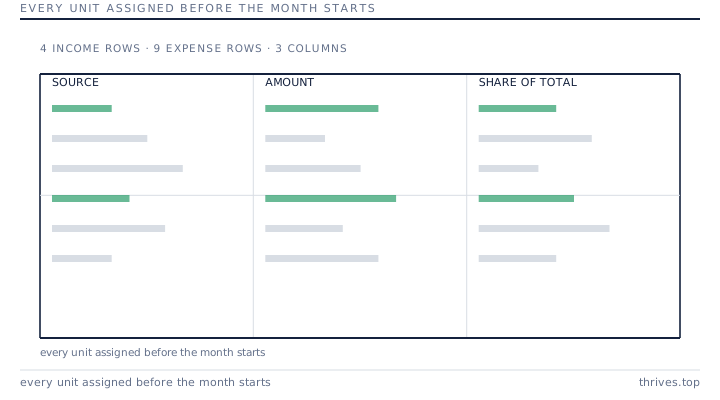
| Primary salary (net) | 01 |
| Secondary income | 02 |
| Side work or freelance | 03 |
| Interest and dividends | 04 |
| Other regular income | 05 |
| Housing (rent or mortgage) | 01 |
| Utilities and internet | 02 |
| Groceries | 03 |
| Transport and fuel | 04 |
| Insurance | 05 |
| Debt payments (minimum) | 06 |
| Healthcare and prescriptions | 07 |
| Emergency fund contribution | 08 |
| Sinking funds (annual bills) | 09 |
How to use this template
- Write your net monthly income at the top of the income column, using the amount that actually lands in your account, not your gross salary. Add every other regular inflow below it and total the column.
- Fill the expense column in order, starting with the fixed costs you cannot change this month: housing, utilities, insurance, minimum debt payments. Read these amounts off last month's statements rather than estimating.
- Assign variable categories next, using the average of the last three months minus ten percent. The subtraction is deliberate: a budget that matches your current spending exactly has no room for the first surprise of the month.
- Assign the remainder in this order: emergency fund contribution, extra debt principal, sinking funds for annual bills, investing, then discretionary categories such as dining and entertainment.
- Check that the unassigned balance is exactly zero. If any amount is left over, assign it explicitly — an unassigned remainder is the money you will spend by accident.
- At the end of week two, compare what you assigned against what you actually spent. Adjust only the two or three lines that are wrong by more than twenty percent, and take the difference from a category you would have spent it on anyway.
- Repeat the review every two weeks on the same day, and rebuild the whole budget only once a year or after a major change in income or housing.
| Primary salary (net) | 01 |
| Secondary income | 02 |
| Side work or freelance | 03 |
| Interest and dividends | 04 |
| Other regular income | 05 |
| Housing (rent or mortgage) | 01 |
| Utilities and internet | 02 |
| Groceries | 03 |
| Transport and fuel | 04 |
| Insurance | 05 |
| Debt payments (minimum) | 06 |
| Healthcare and prescriptions | 07 |
| Emergency fund contribution | 08 |
| Sinking funds (annual bills) | 09 |
Questions people ask
What if my income changes every month?
Use the irregular-income template instead. As a rule of thumb, if your lowest month in the last year is more than twenty percent below your average, a single fixed monthly budget will be wrong in most months.
Should the emergency fund contribution be in the budget or treated as a fixed cost?
Treat it as a fixed cost, placed directly after housing and minimum debt payments. Categories placed at the bottom of the list are the ones that get skipped in a tight month, and the emergency fund is the category you least want to skip.
What counts as an unassigned balance of zero?
Income total minus expense total equals zero. If you are paid on the last day of the month and some spending falls into the next month, split the budget at the payment date rather than forcing a calendar-month boundary.
How long before this stops feeling like work?
Most households report that the second and third months take about half as long as the first, because the category amounts stop changing and only the review remains. Plan for fifteen minutes per pay period after the first month.
Disclaimer: This template is educational information about personal money management, not financial advice. Category amounts must be set from your own statements.